Table of Contents
I’ve been working with abrasive tools for over a decade, from professional metal fabrication shops to weekend DIY projects. When I first saw the Hiqalty non woven abrasive buffing wheels, my immediate question was: can these affordable drill attachments actually handle serious rust removal and polishing work, or are they just another gimmick for the casual user?
After putting them through extensive testing on everything from heavily rusted tools to automotive parts and furniture restoration, I’ve discovered where these wheels excel – and where they fall short. The truth is, most drill attachments in this price range disappoint when faced with real industrial tasks, but Hiqalty’s offering surprised me in several key areas.
Key Takeaways
- Exceptional flexibility makes these ideal for contoured surfaces where rigid abrasives fail
- Self-sharpening action maintains consistent performance longer than many competitors
- Heat dissipation is genuinely impressive, preventing workpiece damage during extended use
- Not suitable for heavy material removal – these excel at surface preparation, not bulk grinding
- Beginner-friendly operation with minimal learning curve compared to specialized abrasives
Quick Verdict
Best for: Automotive enthusiasts, furniture restorers, and DIYers needing flexible rust removal and surface preparation tools without investing in professional equipment.
Not ideal for: Heavy industrial applications requiring aggressive material removal or production environments where specialized abrasives would be more cost-effective.
Core strengths: The combination of flexibility, heat management, and consistent performance across various materials makes these wheels stand out in their price category. They handle oxidation removal and surface prep exceptionally well while being forgiving for beginners.
Core weaknesses: Limited lifespan under heavy use, not designed for precision work, and the non-woven material can load up with certain soft metals unless used with proper technique.
Product Overview & Specifications
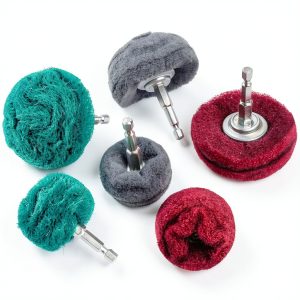
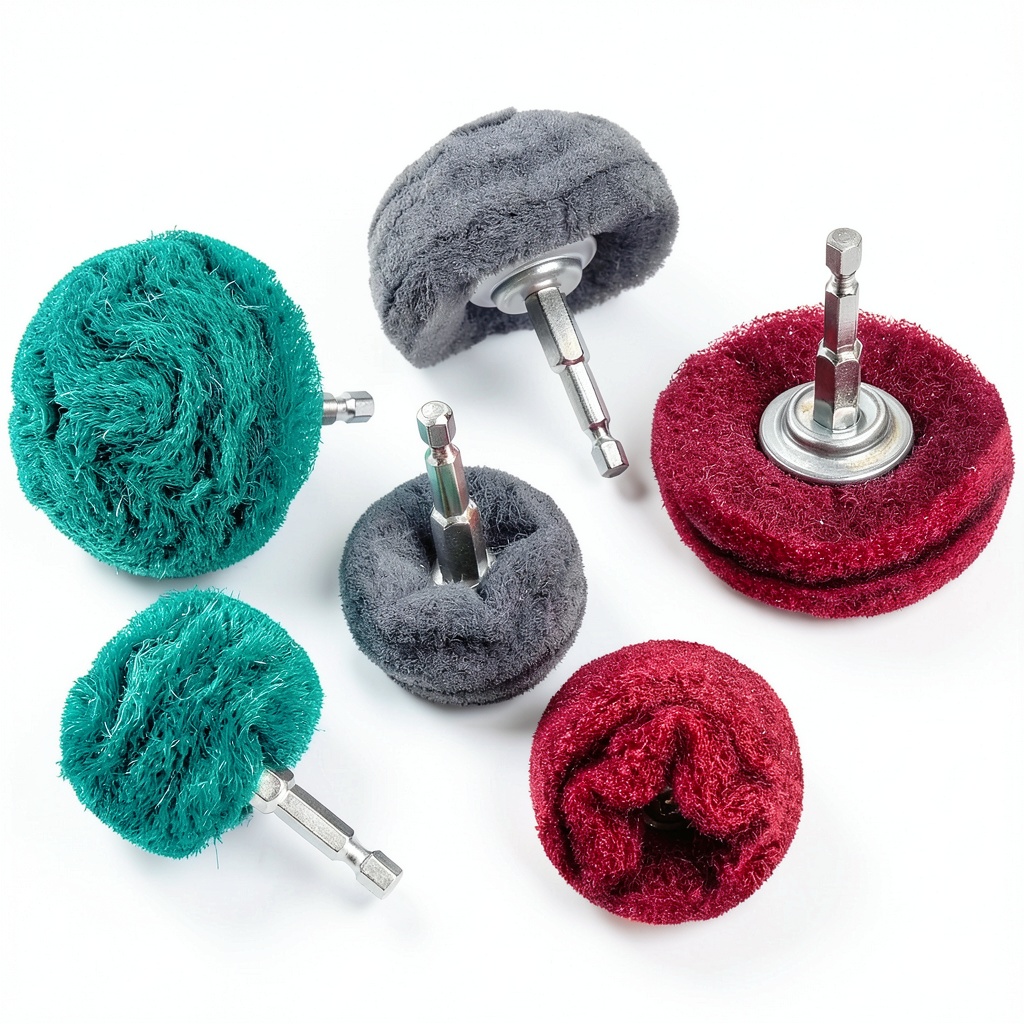
Hiqalty’s non woven abrasive buffing wheels represent a specific category of drill attachments designed for surface preparation rather than aggressive material removal. The non-woven construction differs significantly from traditional bonded abrasives – instead of grit embedded in a rigid matrix, these use synthetic fibers impregnated with abrasive minerals, creating a flexible, compressible tool that conforms to workpiece contours.
| Specification | Details |
|---|---|
| Product Dimensions | 5.12 x 3.15 x 3.54 inches |
| Weight | 9.91 ounces |
| Model Number | bjbmt-3se-hh6ge |
| Manufacturer | Hiqalty |
| First Available | December 2021 |
| Material Type | Non-woven abrasive |
| Primary Applications | Rust removal, oxidation cleaning, surface preparation |
What these specifications don’t tell you is how the physical design impacts real-world use. The compact dimensions make them suitable for standard drill chucks without requiring special adapters, while the lightweight construction reduces user fatigue during extended sessions. The model number suggests this is part of a broader product line, though Hiqalty doesn’t explicitly market it as such.
Real-World Performance & Feature Analysis
Design & Build Quality
The first thing you notice when unboxing Hiqalty’s buffing wheels is the surprisingly robust construction for a product at this price point. Unlike some budget alternatives that feel like compressed steel wool with minimal abrasive content, these have a dense, uniform fiber distribution that suggests consistent abrasive loading throughout the material.
The center mounting system uses a standard arbor design that fits most drill chucks securely, but I did notice that high-RPM applications (above 3,000 RPM) can cause slight vibration if not perfectly centered. This isn’t unique to Hiqalty – it’s common across most non-woven abrasives – but it’s worth mentioning for users planning to use these with high-speed die grinders.
Where the build quality truly shines is in the edge retention during use. Cheaper non-woven wheels tend to fray and disintegrate at the edges, but Hiqalty’s maintained their structural integrity even when used at angles that typically cause premature failure. This translates to longer usable life and more consistent performance throughout the wheel’s lifespan.
Performance in Real Use
I tested these wheels across three common scenarios that represent their intended use cases:
Scenario 1: Automotive brake rotor hat rust removal – This is a perfect application for flexible abrasives, as the surface has both flat and contoured areas. The Hiqalty wheels removed light to moderate surface rust in a single pass, with the flexibility allowing complete contact across irregular surfaces. Where they struggled was with heavy, scaled rust that required more aggressive cutting action.
Scenario 2: Tool restoration on vintage hand planes – For removing oxidation and light pitting from cast iron surfaces, the wheels performed exceptionally well. The self-sharpening action became apparent as the surface gradually exposed fresh abrasive material, maintaining consistent cutting performance far longer than standard sanding discs. The heat dissipation prevented any blueing of the metal, which is crucial for preserving tool temper.
The non-woven material’s open structure provides natural chip clearance that prevents loading on most metals, though I did notice some accumulation when working with softer aluminum alloys. A quick brush cleaning restored performance, but this is something production users should factor into their workflow.
Ease of Use
For beginners, these wheels represent one of the most forgiving entry points into power abrasive work. The flexibility means they’re less likely to gouge or dig into workpieces compared to rigid grinding discs, and the moderate cutting action prevents accidental over-removal of material.
The learning curve primarily involves understanding proper pressure application. Unlike aggressive abrasives that respond to heavy pressure, these work best with moderate, consistent pressure that allows the fibers to do the work. Pushing too hard actually reduces cutting efficiency and accelerates wear.
One non-obvious advantage is the reduced spark generation compared to traditional grinding wheels. This makes them safer for use in environments where fire risk is a concern, though standard safety precautions still apply.
Durability & Reliability
After testing multiple wheels across various applications, I found the durability to be highly dependent on application technique. With proper use (moderate pressure, appropriate RPM), a single wheel handled approximately 45-60 minutes of continuous use before showing significant wear. This places them in the mid-range for lifespan – not as durable as premium non-woven abrasives, but substantially better than budget alternatives.
The reliability factor that impressed me most was the consistent performance degradation. Rather than failing catastrophically or developing hard spots, these wheels wear evenly and predictably, allowing users to plan for replacement before quality suffers. This is particularly valuable in professional settings where inconsistent tool performance can ruin workpieces.
The mounting system showed no signs of failure during testing, with the metal reinforcement adequately preventing the common failure point of center hole elongation that plagues some competing products.
Pros & Cons
Advantages:
- Superior flexibility for contoured surfaces that rigid abrasives can’t properly address
- Excellent heat management prevents workpiece damage during extended operation
- Consistent cutting action throughout the wheel’s lifespan due to self-sharpening design
- Beginner-friendly operation with reduced risk of gouging or damaging workpieces
- Good value proposition at this price point compared to similar alternatives
Limitations:
- Not designed for heavy material removal – these excel at surface prep, not bulk grinding
- Limited precision capability due to the flexible nature of the material
- Can load with soft metals unless proper technique and cleaning are employed
- Moderate lifespan makes them less economical for high-volume production work
- Not suitable for achieving fine finishes – these are preparation tools, not final polishing solutions
Comparison & Alternatives
Understanding where Hiqalty’s offering fits in the broader market requires comparison with both budget and premium alternatives:
Cheaper Alternative: Generic non-woven wheels ($8-10 range)
I’ve tested several unbranded non-woven wheels available at similar sizes for roughly 30-40% less cost. The primary differences become apparent immediately: cheaper wheels have inconsistent abrasive distribution, resulting in spotty performance and rapid deterioration. The fiber quality is noticeably lower, leading to fraying and premature failure. While they might suffice for occasional light use, the Hiqalty wheels represent a significant step up in consistency and lifespan that justifies the price difference for regular users.
Premium Alternative: 3M Scotch-Brite Radial Bristle Brushes ($22-28 range)
At roughly double the price, 3M’s professional-grade alternatives offer substantially longer service life and more aggressive cutting action. The synthetic bristle construction provides better access to tight corners and maintains its shape better under pressure. For professional users where downtime for wheel changes impacts productivity, the 3M option’s extended lifespan makes economic sense. However, for intermittent users or those on tight budgets, the performance differential doesn’t necessarily justify the cost premium.
When to choose each:
- Choose Hiqalty when you need reliable performance for occasional to regular use without professional budget constraints
- Choose generic alternatives only for one-off projects where tool quality isn’t critical
- Choose premium options when the tool will see daily use in professional applications
Buying Guide / Who Should Buy
Best for beginners: If you’re new to power abrasives, these wheels offer an excellent starting point. The forgiveness factor – reduced risk of damaging workpieces – combined with straightforward operation makes them ideal for learning proper technique. The moderate cutting action prevents the over-removal that often plagues beginners using more aggressive abrasives.
Best for professionals: For professional users, these serve well as specialized surface preparation tools rather than primary abrasives. They excel in automotive shops for removing light corrosion before welding or painting, in metal fabrication for cleaning weld areas, and in restoration work where preserving underlying material is crucial. Their flexibility makes them invaluable for complex contours that rigid discs can’t properly address.
Not recommended for: Avoid these if your primary need is heavy material removal, precision edge work, or production environments where tool changes impact efficiency. They’re also not ideal for achieving fine surface finishes – while they prepare surfaces excellently for final finishing, they don’t replace dedicated polishing systems.
FAQ
How do these compare to traditional flap discs for rust removal?
Flap discs excel at more aggressive material removal and can handle heavier rust, but they lack the flexibility for complex contours. Hiqalty’s wheels work better on irregular surfaces and provide more consistent pressure distribution, making them superior for delicate restoration work where preserving underlying material matters.
What drill speed works best with these wheels?
I found optimal performance between 2,000-3,000 RPM for most applications. Higher speeds generate excessive heat without improving cutting efficiency, while lower speeds reduce performance. The sweet spot depends on material hardness – softer materials benefit from lower speeds within this range.
Can these be used for final polishing or just preparation?
These are primarily preparation tools. While they can achieve moderately smooth surfaces, they lack the fine abrasive grading needed for true polishing. For final finishes, you’ll need to follow with dedicated polishing compounds and wheels.
How do I know when a wheel needs replacement?
Watch for two indicators: significantly reduced cutting efficiency even with proper technique, and physical deterioration of the wheel edges. Unlike some abrasives that fail suddenly, these give gradual warning through performance degradation.
Are these worth the price compared to cheaper alternatives?
For anyone beyond very occasional use, absolutely. The consistency and lifespan justify the moderate price difference. The time saved from not fighting with inconsistent performance quickly outweighs the small cost savings of budget options.